Hitler saw elections as mere tools for power. He and his Nazi party worked tooth and nail to win a Reichstag majority. Their sole purpose: destroy Weimar democracy. They succeeded.
The Nazis were participants in six Reichstag elections under Weimar and four after the fall of Weimar democracy.
Here are the complete results of the Nazi Party Reichstag election:
Year of Elections
1924 Reichstag Election Results
There were two Reichstag elections in 1924, in May and December. Both times, the NSDAP performed poorly; compare this to their future gains after the Great Crash of 1929.
1. May 1924 Reichstag Election result
The Nazi Party merges with another ultranationalist party to participate in the Reichstag election. Meanwhile, Hitler was in prison for the failed Beer Hall Putsch during this time. And he has made it ultra-clear that he opposes any election and that a parliamentary form of government is not the way forward for Germany.
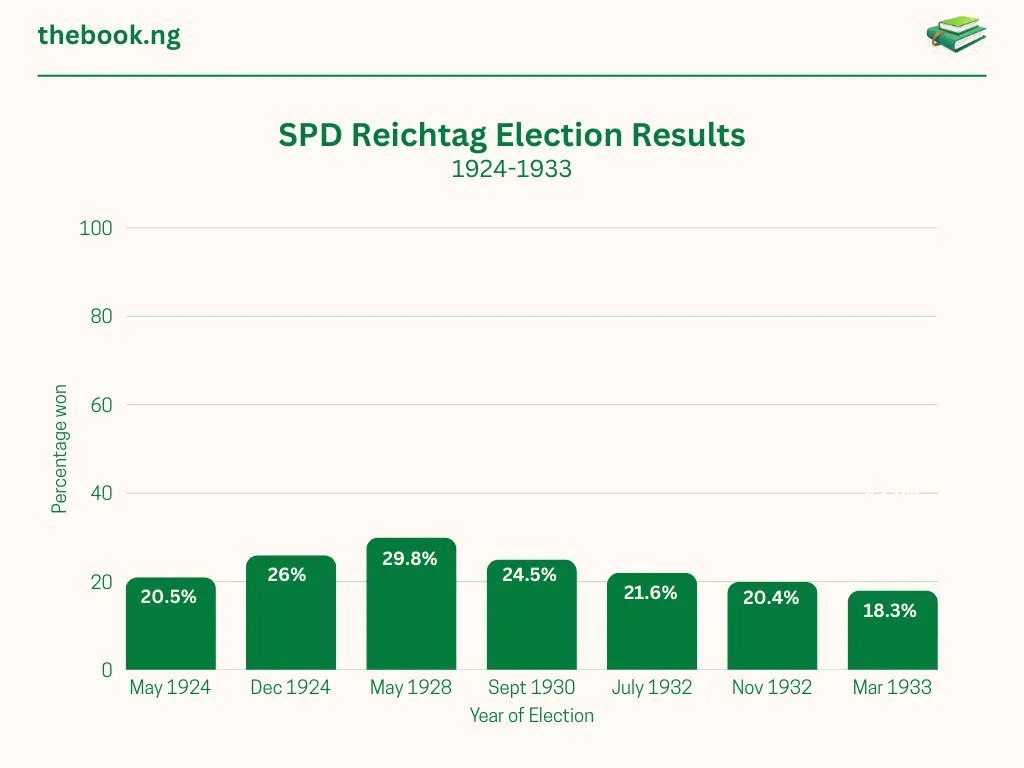
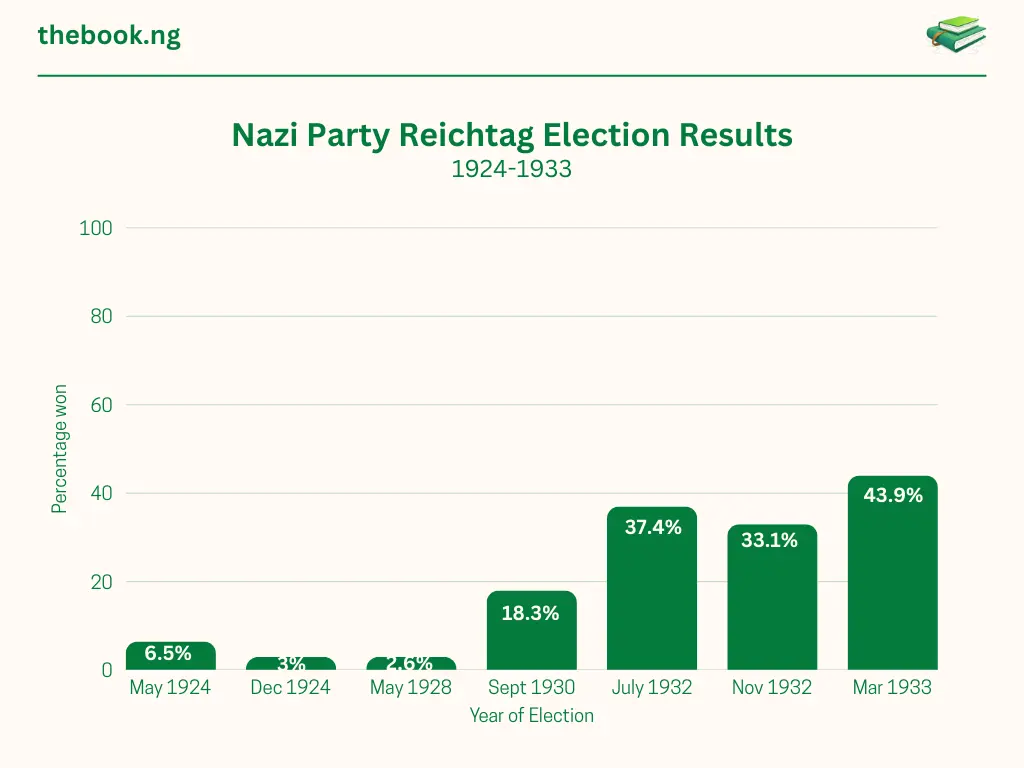
In any case, the election took place, and both parties garnered 6.5% of the total votes, resulting in 32 Reichstag deputies out of a total of 472: 10 for the NSDAP and the rest for the other parties.
May 1924 Reichstag Election Results (Nazi Party major opponent)
- Social Democratic Party (SPD): 20.52% of the total votes
- German National People’s Party (DNVP): 19.45% of the total votes
- Centre Party (Zentrum): 13.37% of the total votes
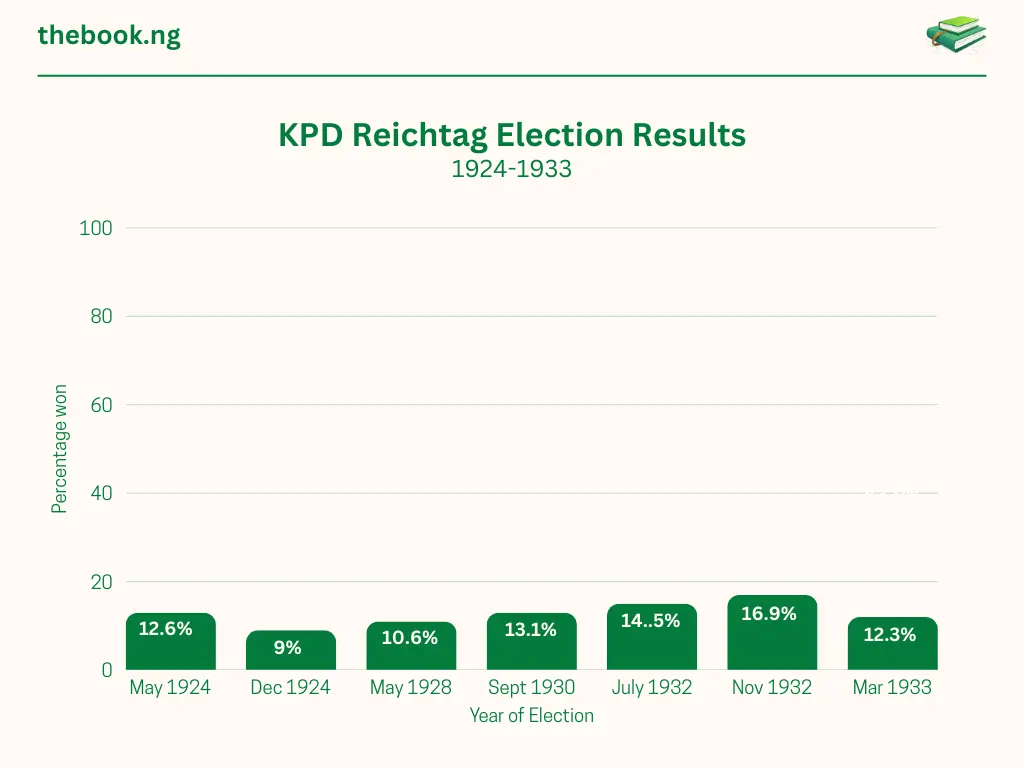
- Communist Party of Germany (KPD): 12.61% of the total votes
- German People’s Party (DVP): 9.20% of the total votes
Ian Kershaw, in Hitler Hubris, called this result a good one for an obscure party like the Nazi Party, attributing it to Hitler’s beer hall putsch trial, which propelled him to the national stage.
2. December 1924 Reichstag election result
The second election was just seven months after the first. The outcome represented a catastrophe for the ultranationalists, which included the young Nazi party.
Both parties succeeded in winning only 14 seats of all 493 seats represented in the Reichstag, compared to 32 seats previously, with the Nazi Party securing only four seats. This illustrates how unpopular the NSDAP was at the beginning of its political life.
December 1924 Reichstag Election Results (Nazi Party major opponent)
- Social Democratic Party (SPD): 26% of the total votes
- German National People’s Party (DNVP): 20.5% of the total votes
- Centre Party (Zentrum): 13.6% of the total votes
- German People’s Party (DVP): 10.1% of the total votes
- Communist Party of Germany (KPD): 9% of the total votes
1928 Reichstag Election Results
Weimar Germany in 1928 was beginning to enjoy a prosperous time, any radical changes were not welcome.
3. May 1928 Reichstag election result
The year leading up to 1928 in Weimar Germany was known as the golden year. This meant that Germany was stable, and the population didn’t want radical changes, as the Nazis had been campaigning.
All this translated into a worse electoral result for the NSDAP; they came ninth. Only 800,000 voters, or 2.6% of the total vote, were in favor of the Nazi Party. That translated to a meager 12 Nazi Reichstag deputies of 491 total, which includes fanatics like Goebbels and Göring.
May 1928 Reichstag Election Results (Nazi Party major opponent)
- Social Democratic Party (SPD): 29.76% of the total votes
- German National People’s Party (DNVP): 14.25% of the total votes
- Centre Party (Zentrum): 12.07% of the total votes
- Communist Party of Germany (KPD): 10.62% of the total votes
- German People’s Party (DVP): 8.71% of the total votes
1930 Reichstag Election Results
The year 1930 is known as the breakthrough year for the Nazi Party. The party’s surge in popularity and its propaganda messages are now in alignment with Germany’s reality.
4. September 1930 Reichstag election result
The Weimar Golden Year has just ended, and Germany has been plunged into utter chaos. The German population demanded the radical changes that the Nazis had been campaigning for.
The December 1930 Reichstag election was a breakthrough not for Germany but for the Nazis. Some 6.8 million German voters voted for the NSDAP, which translated to 107 Nazi deputies out of a total of 577. Compared to just two years earlier, Hitler had increased the party’s popularity eightfold and become the second largest political party in Weimar Germany.
September 1930 Reichstag Election Results (Nazi Party major opponent)
- Social Democratic Party (SPD): 24.53% of the total votes
- Communist Party of Germany (KPD): 13.13% of the total votes
- Centre Party (Zentrum): 11.81% of the total votes
- German National People’s Party (DNVP): 7.03% of the total votes
- German People’s Party (DVP): 4.51% of the total votes
1932 Reichstag Election Results
The Nazis has now settled into the government but still hasn’t achieved its aim of a majority in the Reichstag. It needed the majority to dismantle the unsatisfying Weimar democracy.
5. July 1932 Reichstag election results
By now, the Nazis’ popularity has been rooted in Germany, and it continues to grow significantly. That was why Hitler had been calling for another Reichstag election, hoping his party would now win more massively than the previous election.
He was right. The Nazis more than doubled their Reichstag deputies in the July Reichstag election. 37.4% of all votes go to the Nazi deputies. increasing from 107 representatives to 230 of the total 608 Reichstag deputies; that’s more than they were even hoping for. But the Nazis are still not satisfied. They want the majority.
July 1932 Reichstag Election Results (Nazi Party major opponent)
- Social Democratic Party (SPD): 21.58% of the total votes
- Communist Party of Germany (KPD): 14.32% of the total votes
- Centre Party (Zentrum): 12.44% of the total votes
- German National People’s Party (DNVP): 5.91% of the total votes
- Bavarian People’s Party (BVP): 3.23% of the total votes
6. November 1932 Reichstag election results
This was the last free and fair election before the arrival of the Third Reich. The Nazis actually did worse; it showed the German population was still unsure whether they wanted a majority of Nazis in the house.
The NSDAP lost two million votes, most of which went to its archenemy, the Communists. Its deputies in the Reichstag were now down to 196 instead of the previous 230 of the total 584 deputies.
November 1932 Reichstag Election Results (Nazi Party major opponent)
- Social Democratic Party (SPD): 20.4% of the total votes
- Communist Party of Germany (KPD): 16.9% of the total votes
- Centre Party (Zentrum): 11.9% of the total votes
- German National People’s Party (DNVP): 8.3% of the total votes
- Bavarian People’s Party (BVP): 3.1% of the total votes
1933 Reichstag Election Results
At the instant Hitler became chancellor of Germany, he targeted the destruction of the Weimar democracy.
7. March 1933 Reichstag election results
The Nazis still did not get the majority of votes it was hoping for in 1933, even though the Nazis were in power. Although it managed to obtain 17 million votes from voters, which wasn’t without thorough intimidation and visible violence. That makes 288 Nazi deputies of the total 647 Reichstag deputies.
When combined with the German National People’s Party (DVNP), the Nazis finally secured a majority in the Reichstag, allowing Hitler to push forward with his plans. He acted quickly; just three weeks after the election, the Enabling Act was passed on 24 March 1933, effectively destroying the Weimar democracy.
March 1933 Reichstag Election Results (Nazi Party major opponent)
- Social Democratic Party (SPD): 18.3% of the total votes
- Communist Party of Germany (KPD): 12.3% of the total votes
- Centre Party (Zentrum): 11.3% of the total votes
- German National People’s Party (DNVP alliance): 8.0% of the total votes
- Bavarian People’s Party (BVP): 2.7% of the total votes
Other Elections and Finale…..
Before the next election in November 1933 and subsequently in 1936 and 1938, all political parties had been successfully banned by Hitler except the Nazi Party. In effect, only the Nazis legally competed in those elections, and all seats were wiped clean. Every Reichstag deputy from November 1933 till the end of the Third Reich was an NSDAP member.
Source
- Feuchtwanger, E. J. (1995). From Weimar to Hitler: Germany, 1918–33. Palgrave Macmillan.
- Evans, R. J. (2003). The Coming of the Third Reich. Penguin Books.
- Kershaw, I. (1998). Hitler, Hubris: 1889-1936. Penguin Books.

Pingback: Hermann Göring: The Rise and Fall of the Notorious Nazi leader (Summary) - The Book