Ferdinand Schörner was a field marshal in the Wehrmacht and the final commander-in-chief of the German army (OKH). And after the Second World War’s end, he was convicted and imprisoned for his war crimes by the Soviets.
EARLY LIFE
Schörner was born on 12 June 1892 in Munich, Germany, the future birthplace of the Nazi Party. He served in the Bavarian army, and by 1914, he was promoted to Leutnant der Reserve. During the First World War, he fought valiantly in the Battle of Caporetto and won himself the Pour le Mérite. Afterward, with the creation of the Reichswehr during the Weimar Republic, Schörner served as a staff officer and participated in the defeat of Hitler’s Beer Hall Putsch. At this time, he was an adjutant to General Otto von Lossow.
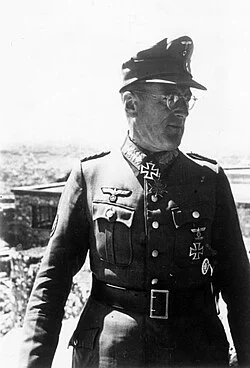
WORLD WAR II
Schörner did well in the Wehrmacht during World War II. He commanded the 98th Mountain Regiment during the invasion of Poland in 1939. Later, Schörner earned the Knight’s Cross with the German 6th Mountain Division during the 1941 Balkan campaign. He also took part in Operation Barbarossa, in June 1941, with the same mountain division. In 1942, his career advanced when he was promoted to lieutenant general, then was made commander of Army Group A in March 1944 and, in May, commander of Army Group South Ukraine. Following this, Schörner was promoted to the rank of general of the army in May 1944, and with this new rank, he commanded Army Group North in July.
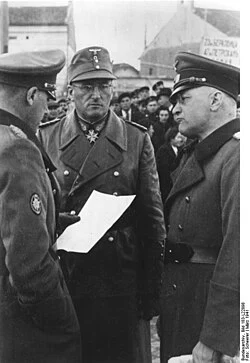
By March 1945, when the Third Reich had almost collapsed, Schörner had become a favorite general in the circle of high-ranking Nazi leaders, including Hitler and Goebbels. As a result, he was promoted to field marshal and was named the commander in chief of the OKH, a post he retained until the official surrender of the Third Reich on May 8, 1945.
The last report that came from Schörner just before the official surrender was on 2 May 1945. In the report, the field marshal intended to surrender his men to the Americans, not the Soviets. But on May 8, he deserted his men and flew to Austria, where he was arrested by the Americans on May 18.
Post-war conviction
A few weeks after his arrest, the Soviets acquired him from the Americans, and he was charged with war crimes and sentenced to 25 years’ imprisonment. A decree of the Soviet Union for an unknown reason reduced this sentence to 12 and a half years, and another decree handed him over to East German authorities in 1954. Later in 1955, he was released. Schörner found his way to West Germany, where he was again charged with crimes committed against the German army and was sentenced to four and a half years in prison. He was the last surviving field marshal at the time of his death in July 1973.
Final Assessment
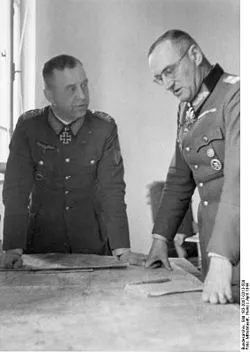
Schörner was despised by German veterans for his order of 1945, where he stated that soldiers found guilty of desertion should be summarily executed on the spot. Goebbels loved him for this. This feeling was also recorded in Goebbels’ diary in March 1945. In the diary entry, Goebbels writes that Schörner’s method is naturally effective and that this harsh measurement would instill adequate fear in the minds of the front soldiers, preventing them from deserting their posts for any reason.
In historical literature, Ferdinand Schörner is widely represented as a simple disciplinarian and a blind devotee of Hitler’s no-step-back orders, even after Nazi Germany had technically lost the Second World War in 1942/43. However, more recent research by American historian Howard Davis Grier and German historian Karl-Heinz Freiser has depicted Schörner as a talented commander with astonishing operational ability in managing an army group of 500,000 men on the Eastern Front in 1944. He was harsh against superiors and subordinates alike and known to disobey Hitler’s orders on operational matters whenever he saw fit.
Awards and decorations
Ferdinand Schöner was a valiant soldier despite his cruel attitude toward his fellow army soldiers. This could be validated with awards and decorations bestowed upon him during his years of service. In 1914, he won the Iron Cross, first and second class, and later received its clasps in 1939. Another grand military award bestowed upon him was the Knight’s Cross with Oak Leaves, Swords, and Diamonds. He was also awarded the Golden Party Badge, the most prestigious Nazi Party award, given to members between 1 and 100,000 before January 1933.
Wikipedia contributors. (2026, April 6). Ferdinand Schörner. Wikipedia. https://en.wikipedia.org/wiki/Ferdinand