Walther Wenck was the youngest Wehrmacht general, and after World War II, he became an industrialist. He commanded the Twelfth Army that took part in the Battle of Berlin. Later in 1957, he declined an offer by the West German government to become the inspector general of the Bundeswehr.
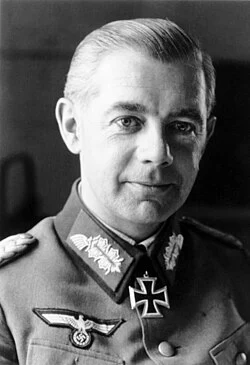
Early Life
Walther Wenck was born on September 8, 1900, as the third son of an officer in Wittenberg, Germany. In 1919, like many young men of his time, he joined the Freikorps, a paramilitary group, and then the Reichswehr of the Weimar Republic in 1920.
World War II Career
Wenck served as chief of operations at the outbreak of World War II for the 1st Panzer Army from 1939 to 1942. In 1942, he was chief of staff for LVII Corps and then the Romanian Third Army on the Eastern Front. Later in 1943, he became the chief of staff for the 6th Army that was destroyed by the Red Army in Stalingrad. From 1943 to 1944, he was chief of staff for the 1st Panzer Army and then, in the same capacity, was upgraded to Army Group South Ukraine. He met Hitler while serving here.
On July 22, 1944, Wenck was appointed by Heinz Guderian as chief of operations at the OKH, when the latter himself had just been appointed by Hitler as OKH chief of staff. From here, Wenck became the chief of command staff, an upgrade to his last appointment.
After a long argument on February 3, 1945, Guderian successfully persuaded Hitler to appoint Wenck as chief of staff of Army Group Vistula under Heinrich Himmler. In this capacity, he was authorized to launch an attack against the advancing Red Army. At first, the attack was successful, but then it failed due to countless variables. On February 17, Wenck had an accident while driving to attend Hitler’s daily briefing as per Hitler’s request. He was saved by his driver, Dorn, but he still suffered a fractured skull.
On April 10, 1945, Wenck was appointed commander of the Twelfth Army, whose mission was to shield Berlin from the Western Allies advancing from the west of the city. He soon realized that his battle area was more of a refugee camp for Germans fleeing from the Soviet army. Wenck was recorded to feed many of these refugees alongside his own men.
Battle of Berlin
By April 21, Marshal Zhukov’s 1st Belorussian Front and Marshal Konev’s 1st Ukrainian Front were encircling Berlin from the north and south. The planned attempt by Hitler to save Berlin now fell on Wenck’s Twelfth Army. Wenck’s mission, as suggested by Alfred Jodl, was to march his men from west to east and link up with the Ninth Army under General Theodor Busse. Together, they’ll break the Soviet encirclement. All this was easier said than done. The Soviet force was too powerful; Wenck’s men were unable to reach Berlin. By April 27, Berlin had been surrounded by the Red Army, and the forces in and out of the city were cut off, the Twelfth Army included.
According to Wenck, fighting the Soviets was a futile effort at this point in the war. As a result, starting from April 24, he diverted his twelfth army away from the advancing Red Army into territories occupied by the Americans, along with the remaining Ninth Army and civilians.
In The Fall of Berlin, Beevor concluded that Wenck intentionally worked to create an escape route for the German population during the battle for Berlin. Another authoritative source claimed that Wenck was able to evacuate hundreds of thousands of his troops and civilians to US Army-occupied territory.
Post-War Life and Death
After the end of World War II, Wenck was arrested by the US Army and was tried but not convicted. As a result, he was released in 1947 and began a second career as an industrialist. During the 1950s and 1960s, he worked as director for Dr. C. Otto & Co. and the Diehl Group. In 1957, Wenck declined an offer to become the Inspector General of the Bundeswehr. On May 1, 1982, his car crashed while driving, and he died as a result and was buried in his hometown in Lower Saxony a few days later.
Awards and Decorations
All of his awards and decorations came after the outbreak of the war in 1939. They are:
- Iron Cross, 1st and 2nd class, in 1939
- German Cross in Gold in January 1942
- Knight’s Cross of the Iron Cross in December 1942.
Source: Wikipedia contributors. (2025, December 9). Walther Wenck. Wikipedia. https://en.wikipedia.org/wiki/Walther_Wenck