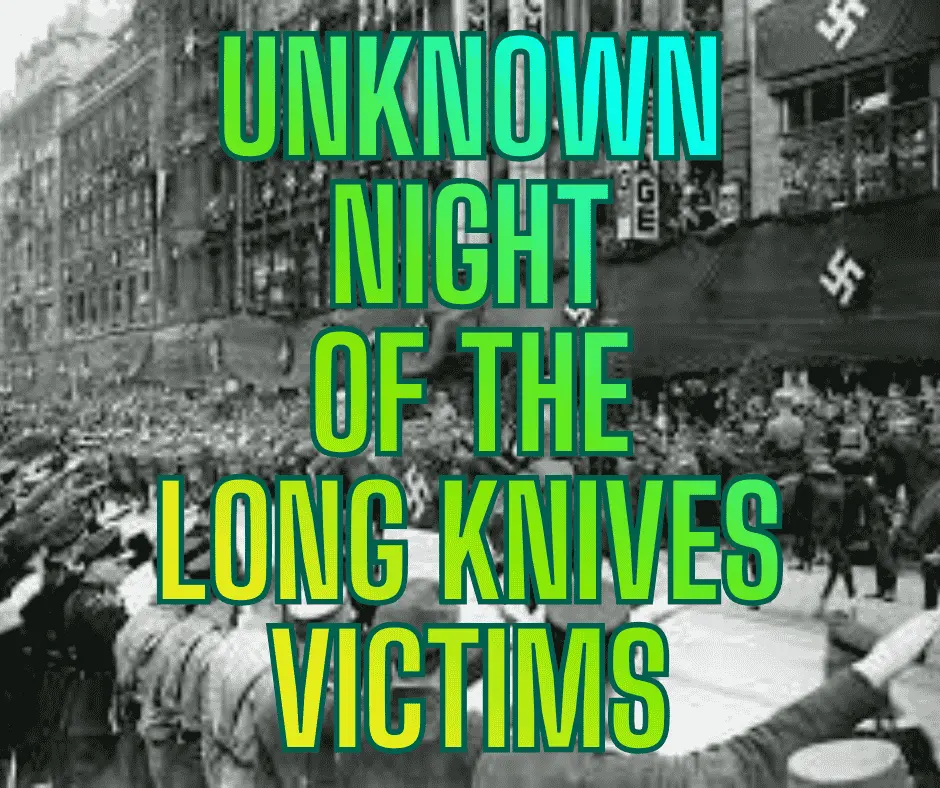
The worldwide narrative for the killings of the night of the long knives was the elimination of the coup d’etat planner, which was supposed to be just the SA. But behind the scene, Hitler and his gunmen were killing their enemies.
Here are 13 of the unknown victims of the Night of the Long Knives.
1. General Kurt von Schleicher
He was the chancellor just before Hitler’s appointment. And also a former senior officer in the Reichswehr (later Wehrmacht). He was on Hitler’s kill list just because he may or may not have said Hitler was unfit to hold office.
On the morning of June 30, 1934, he was shot dead by the SS alongside his wife in his home. And the German Army was fool enough not to confront Hitler until much later.
2. Major-General Kurt von Bredow
He was not supposed to be on the hit list because he had no grudges with the Nazis. He was just killed because of his proximity to General Schleicher.
3.Gustav Ritter von Kahr
Kahr was targeted because he had suppressed Hitler’s coup d’etat in 1923. His body was found hacked by the SS in the proximity of Dachau.
4. Gregor Strasser
Gregor Strasser had ideological differences with Hitler since the Nazi Party was young. By 1934, Strasser had retired from politics, but Hitler refused to let him live. Instead of the SS, Hitler ordered the Gestapo to arrest Strasser and have him shot dead.
5. Herbert von Bose
Von Bose was unlucky because of his closeness with Papen. The vice chancellor himself was slightly lucky not to be a victim in the bloodbath. He was shot at Papen’s own office.
6. Edgar Jung
Another unlucky victim of error in the night of the long knives. He too was targeted because of his closeness with Von Papen. Or maybe Hitler was sending a direct message to Papen not to interrupt his government in any way.
Papen himself narrowly escaped death, deemed too prominent a figure for a simple murder, but two of his closest associates were killed, sending a clear warning to the conservative elite.
7. Dr. Erich Klausener
Another Papen inner circle to suffer death during the night of the long knives. He wouldn’t have had any connection with the revolution Hitler claimed Rohm wanted.
Now it’s clear that the Nazis were sending a strong warning to Papen and his Catholic members to not meddle with their government.
8. Dr. Wilhelm Eduard Schmidt
An accidental killing during the night of the long knives. The Nazis weren’t remorseful with the deceased family; instead, his burnt ashes were sent to his wives and children.
9. Dr. Karl-Gunther Heimsoth
He had secret knowledge of Rohm’s homosexuality, which made him a liability for Hitler. He was shot dead alongside others. He too had no plan for a revolution.
10. Dr. Fritz Gerlich
In Hitler’s Germany, definitely, knowing too much was a dangerous thing; you paid with your life. He was a journalist who was aware of Hitler’s predatory actions that led to Geli Raubal’s death. Geli was Hitler’s cousin; Dachau was where Fritz met his untimely death from the SS.
11. Otto Ballerstedt
In the early years of the Nazi party, he successfully sent Hitler to a month in jail. Hitler was at fault. The then future fuhrer and his young thugs were abrupt where Ballerstedt was speaking in 1921. Hitler didn’t forget. He used the Rohm Chao to order Ballerstedt’s death.
12. Dr. Voss
He was Gregor Strasser’s lawyer, whose sole association with his client made him a Nazi target. He was gunned down too during OPERATION KOLIBRI (codename for the night of the long knife).
13. Father Bernhard Stempfle
Hitler was definitely trying to cover his involvement in Geli’s death. Father Stempfle was targeted due to his over acknowledgment of Hitler’s involvement in Gel
Finale…..
This is just how Hitler operated since the beginning of his political career. He downgrades whoever opposes his views, even if it means killing them. And upgrade those that agree with him, even if they’re really wrong.
Sources
- Evans, R. J. (2003). The Coming of the Third Reich. Penguin Books
- Kershaw, I. (1998). Hitler, 1889–1936: Hubris. Penguin Books
- Feuchtwanger, E. J. (1993). From Weimar to Hitler: Germany, 1918-33. Palgrave Macmillan