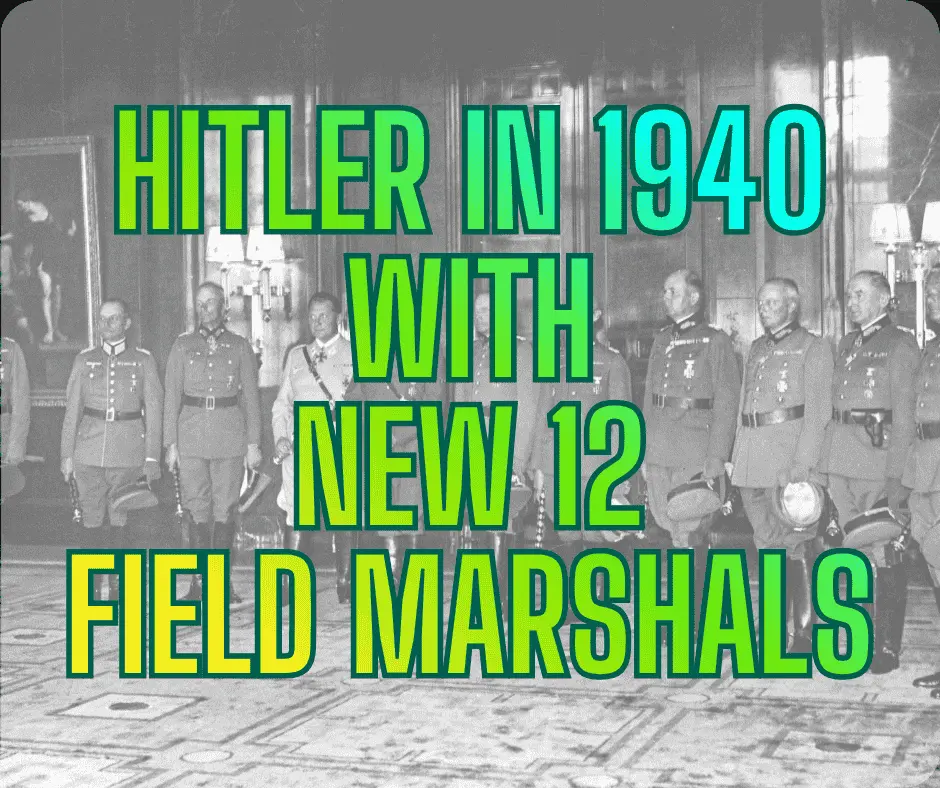
Since the beginning of Hitler’s career as a politician, he only surrounded himself with loyalists. Those opposed to his view had to go, even if they were objectively right. And after he became German chancellor, this trend continued and even escalated during Nazi Germany’s invasion of Europe.
Throughout the war, it is hard to pinpoint exactly the number of generals fired by the Führer. So, in this post, I’ve compiled the list of the most important generals and field marshals Hitler fired during the Second World War.
Generals in a glance
1. Reich Marshal Hermann Göring
Göring has been falling out of favor with Hitler since the Luftwaffe started accruing losses in the Battle of Britain. But he wasn’t dismissed until the last weeks of the Third Reich in 1945.
On March 22, 1945, Göring sent a letter to the Führerbunker saying he’d assume Hitler’s role, thinking Hitler was no longer capable. But the letter met with Bormann, who exploited the situation and convinced Hitler that Göring was a traitor. The second day, Hitler was convinced, dismissed him, and stripped him of all his official titles.
2. General Erich Hoepner
General Erich Hoepner was a clear-eyed tank commander who had recognized the weaknesses of the Wehrmacht as early as 1941. When he decided to withdraw his 20th Army from the encircled Red Army to a stronger, more defensible position, it was a sound military choice—but one that defied Hitler’s orders. For that decision alone, Hitler dismissed him in January 1942.
3. Field Marshal Gerd von Rundstedt
The field marshal was sacked by Hitler because he refused the order not to rescue his men from the Soviets’ clutches in December 1941. But after Hitler went to assess the situation, he admitted the field marshal’s judgment had been right. But he was fully dismissed in March 1945.
4. Field Marshal Johannes Blaskowitz
He was a professional officer from WWI whom Hitler appointed for military administration in Poland after the invasion of the country.
When he saw the atrocities committed by the SS, he complained twice to Hitler about what he had seen. Hitler saw the lamentation as childish and dismissed him in 1940.
5. Colonel-General Gotthard Heinrici
General Heinrici was the chosen one for the defense of Berlin in 1945. He was commanded by his superior officers to save the city from the notorious Red Army. He could never fulfill this duty even if all the men needed were at his disposal. He was the last senior officer to be relieved of his post by Hitler on April 29, just a day before the death of the Führer.
6. Reichsführer-SS Heinrich Himmler
Himmler was considered by German historians as the authentic second man in the Third Reich, below Hitler. But he, too, became disgusted with the Führer as soon as he had a major military loss while commanding the Army Group Vistula. But he still wasn’t dismissed until Hitler had evidence he was capitulating and negotiating a surrender in the name of the whole Reich. He would be stripped of all his official titles and posts in the final days of April 1945.
7. Field Marshal Ernst Busch
General Ernst Busch was dismissed for the destruction of the Army Group Center in the Soviet Operation Bagration. No German general could have done magic to turn the war positive. Hitler just used the general as a scapegoat.
8. General Franz Halder
General Franz Halder was dismissed by Hitler in September 1942 even though he had had massive success during the eastern invasion. His replacement was Kurt Zeitzler, who’d also be sent home by Hitler in January 1945.
9. Field Marshal Wilhelm Ritter von Leeb
Ritter von Leeb was one of the reasonable senior officers who couldn’t stomach Hitler’s destructive orders during the Wehrmacht’s early defeat in 1943. He went on early retirement the same year.
10. Field Marshal Erich von Manstein
Manstein tweaked and perfected Guderian’s blitzkrieg for the Wehrmacht invasion of France. But as the Second World War dragged on and Germany started losing on multiple fronts, every good general became the enemy in the view of Hitler.
His dismissal came in March 1944 over a heated disagreement about withdrawal from the Eastern Front with Hitler. But to ease pain, he was awarded the ‘Swords to the Oak Leaves of the Knight’s Cross,’ the Wehrmacht’s highest military decoration during World War II.
11. Field-Marshal Walther von Brauchitsch
He was the German commander-in-chief during the first two years of World War II. His resignation came after he suffered a heart attack in November 1942 and was accepted by Hitler, who became the chief commander in December 1942.
12. Field Marshal Hugo Sperrle
Hugo Sperrle commanded the Luftwaffe that successfully bombed Spain in the Spanish Civil War in 1937. But later, in the Second World War, he was unable to match the Allies in the air. And the furious Hitler sent him home in July 1944 after the Allies landed on Normandy.
13. General Heinz Guderian
He invented blitzkrieg, which helped Hitler win important invasions, including Poland and France. But that still doesn’t save him from being fired by the Führer twice.
First, in 1941, over a tactical disagreement with Hitler, and then finally in March 1945.
14. Field Marshal Günther von Kluge
After the July 20 plot failed, Hitler became suspicious of everyone, including Field Marshal von Kluge, even though he wasn’t involved in the plot. Shortly after, Hitler radioed him of his dismissal in August 1944, and he was replaced by a more obedient Walter Model instantly.
15. Colonel General Josef Harpe
Harpe became prominent in the Wehrmacht when he was given the command of the deteriorating Army Group A in 1944. He was dismissed based on the fact that he saved his men from the destructive Soviet invasion of Germany in January 1945.
16. General Kurt Zeitzler
From September 1942 to June 1944, Kurt Zeitzler replaced Franz Halder as the chief of the general staff in the Wehrmacht until he suffered a nervous breakdown. But what causes his nervous breakdown?
It was a series of realities of the war that he tried to show Hitler, which Hitler refused to see. And Zeitzler could not stomach the gallant loss, causing him to break down. But he wasn’t finally dismissed until January 1945.
17. General Friedrich Hoßbach
Friedrich Hoßbach clashed with his newly appointed superior officer over the withdrawal of his 4th Army on the Eastern Front. He argued for a withdrawal, but when the news arrived at Hitler’s ear on January 30, 1945, he fired General Hoßbach instantaneously.
18. Field-Marshal Ewald von Kleist
He wasn’t among the 12 senior officers promoted to field marshal by Hitler in the mid-1940s. Rather, his promotion to field marshal came in 1943 alongside General Paulus. Von Kleist was dismissed in March 1945 when no miracle could be performed to save the Germans from the Allies’ victory.
19. Field Marshal Fedor von Bock
He was regarded as a correct Prussian officer who loved Hitler’s nationalistic idea. He commanded the furious Army Group Center that invaded Russia in 1941 until he suffered a health crisis the same year. Not long after, he submitted his resignation in July 1942, and Hitler didn’t protest and gladly sent him home.
20. Waffen-SS Colonel General Paul Hausser
Paul Hausser was a Colonel-General of the Waffen-SS and Commander-in-Chief of Army Group G in southern Germany in 1944-45. He was relieved of his post in March 1945 by Hitler because he retreated his men from the bombardment of the Allies on that front of the war.
21. Georg-Hans Reinhardt
Hitler was joyous at his generals’ overperformance during the early years of the Second World War, but when the inevitable defeat came, he raged at everyone. Colonel-General Georg-Hans Reinhardt was sacked by Hitler in January 1945 when he withdrew his 4th Army from an imperiled position to a secure one. The general was sent home alongside his chief of staff.
Finale…..
The senior officer in the Wehrmacht should have seen the writing on the wall since Hitler had murdered Rohm, who was clearly useful for him and the Nazi party. But when Rohm proved disobedient, Hitler removed him completely. During World War II, Hitler needed those generals; he could never act rashly; dismissal was the only thing he could do.
To be clear, most of these senior officers were only dismissed from Hitler’s immediate proximity, not completely from the army. And many survive the war and even thrive after the Nuremberg trials.
Sources
- Kershaw, I. (2011). The end: The defiance and destruction of Hitler’s Germany, 1944–1945. Penguin Books
- Evans, R. J. (2008). The Third Reich at war, 1939–1945. Penguin Books.