
Table of Contents
The Summary
Atomic Habits by James Clear shows how small changes with consistency lead to amazing results. He learned this firsthand, recovering from an injury, proving that small improvements add up.
Just forget about setting goals; it won’t do you any good. Focus instead on building solid systems. As said in the book, “You do not rise to the level of your goals. You fall to the level of your systems.” Habits are like compound interest for self-improvement—their effects grow exponentially over time.
Clear argues that all human actions follow a simple loop: cue, craving, response, and reward. Charles Duhigg’s book ‘The Power of Habit’ (Cue, Routine, and Reward) also supports this annotation.
This is how habits form, and James Clear turns it into four laws to create good habits and stick with them and break bad ones for good.
To create lasting good habits, you have to make their cues obvious. Carry a book with you to become a habitual reader.
For bad habits, hide their cues. Silent group notifications on WhatsApp to avoid picking up the phone every time it buzzes with a notification.
Make good habits appealing by pairing them with something you enjoy or joining groups where they’re normal. To break bad habits, change your mindset to see their downsides.
Good habits should be effortless. Start small with the Two-Minute Rule. Fold your clothes, set an alarm at night to wake you early in the morning, all in less than two minutes.
For bad habits, create obstacles and make them hard to do. Keep your phone in the other room to avoid distractions while working.
We repeat what feels good. Track your good habits for honest measurement. For bad habits, create immediate consequences to make them unappealing.
Notable stories from the book
- The losing British cycling team hired a new director who introduced 1% improvement and made them a champion for years. (Page 13)
- The broke French philosopher, Denis Diderot, suddenly got rich just before his daughter’s wedding. One unthinking spending leads to another (in another source: he later died broke). (Page 72-73)
- A stockbroker who tracked his sales phone calls by transferring 120 paperclips from a full jar to an empty one every day. (Page 195)
How Long Would It Take To Read The Book?
Well, the easiest way to find that out without actually reading the book is to ask ChatGPT, so I did. This is what it said:
| Time Per Day | Slow (150 wpm) | Average (200–250 wpm) | Fast (300 wpm) |
| 15 mins/day | 33 days | 26–29 days | 17 days |
| 30 mins/day | 17 days | 13–15 days | 9 days |
| 1 hour/day | 8-9 days | 6–7 days | 4–5 days |
| 2 hours/day | 4-5 days | 3–4 days | 2–3 days |
In short, it’ll take an average reader up to 15 days, considering they have decent time to spend on Atomic Habits.
To know how fast you can read, do a test here
But what you really want to know is how long it took me to read the Atomic Habits. That’s easy. I spent around 20-25 mins reading 10 pages; that’s 2-2.5 mins per page. Considering the book is enjoyable, it’ll take around 18-20 days of 30 minutes per day to finish it, minus the index section.
What Tool in the Book Do I Use Regularly?
All tools mentioned in the book are worth checking, but not all are for everyone. Some people might specifically choose to design their environment to make their habits stick. That’s the one they chose and work for them.
The two-minute rule mentioned in Chapter 13 is one of my favorites. It helps me get small things done instantly. You can also call it ‘start small.’
The tool I actually use regularly that’s mentioned in the book is habit tracking for many reasons. First, there are multiple studies that have been done to prove that tracking a habit helps stick to the habit.
Secondly, I was able to measure every habit versus each month. The tracking allows me to see clearly what habit I should improve on or what habit has already stuck.
How much does the Atomic Habits cost me?
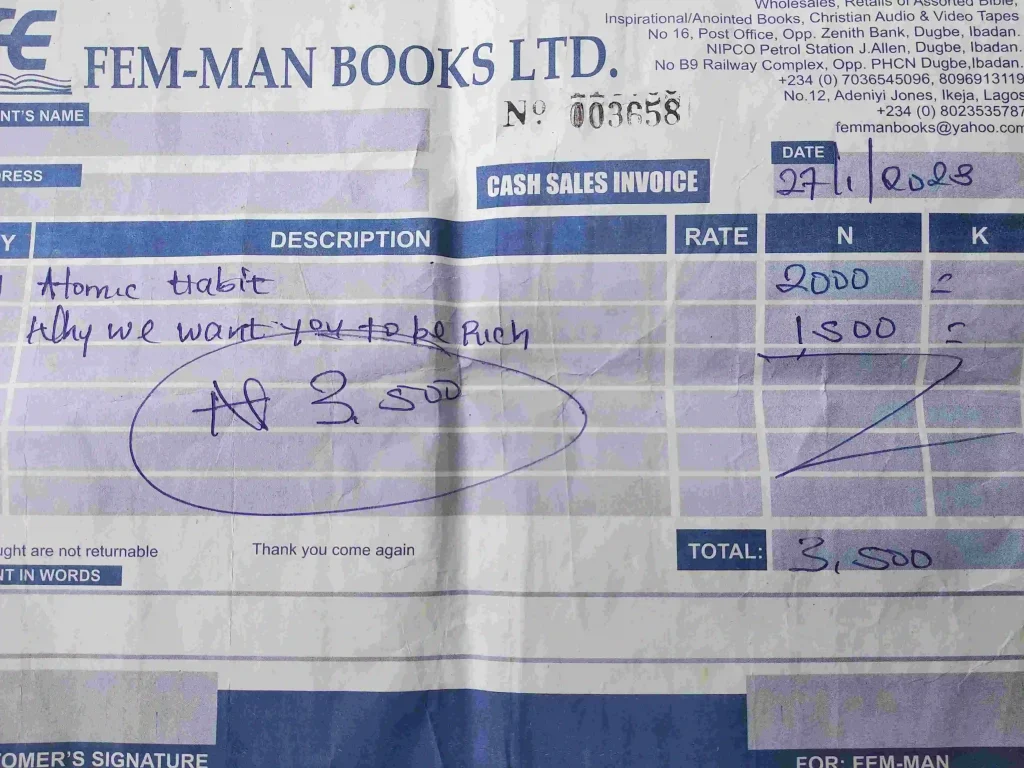
It cost me ₦2,000 to buy the Atomic Habits paperback in January 2023 when I got it in a bookshop in Ibadan. Checking Konga, it now stands at ₦4,500.
If Amazon is where you want to find your Atomic Habits, then be prepared to pay the sum of $10-$15 for the English edition.
Other Best Related Books on Habits
Mastery by Robert Greene: To gain mastery, Greene explains that one has to deliberately repeat an action over a long period of time.
Tiny Habits by BJ Fogg: This habit book is a bestseller by a Stanford University behavior scientist that emphasizes starting a new habit small and growing naturally. It’s worth a read.
The Power of Habits by Charles Duhigg: This book didn’t provide any tools like Atomic Habits. What it gives, however, is the total inner workings of habit formation, which is more powerful than any habit-forming tool.



1 thought on “Atomic Habits: James Clear Summary”
Pingback: Books I've Read Since 2022 - The Book